lunes, 28 de mayo de 2018

SCHOOL PARTY

Summer is arriving, and some of our students are going to go on holidays. To say good bye to them, we have decided to do a school party.

We have prepare a lot of funny activities and a delicious lunch; we made ice creams, we painted on the playground, we did races, we sang summer songs, etc. In de lunch we ate a lot of tasty food.
It was fantastic!!!

 Resultado de imagen de niños de 2 años corriendo


Resultado de imagen de niños cantando


TACONERA EXCURSION

Last friday, we went to La Taconera. We went walking because our infant school is near this place. At 9:00 pm we left the school and around  9:45 we were at there.
We saw the animals such as the peacock, the hens, the swans, the deers etc. Also, we saw the nature of La taconera that is very beautiful and has a lot of grass, flowers...
Children learn a lot about the animals and the nature and they also had a new experience in their lifes. 
This excursion was so enriching for them.


martes, 22 de mayo de 2018

ARTICLE

Let's Play! My Little Thumbkin & Sticky Situation

Fingers are fascinating to your baby because he's discovering how much they can do. In the classic children's singing game "Where Is Thumbkin?" the individual digits of each hand really come to life.

Appropriate for: 9 months to 2 years
Skills developed: Fine motor, auditory
What you'll need: A nonpermanent pen

Use a pen to draw a small face on the pad of each of your fingers and both thumbs. Start by making fists and holding them both out in front of your baby, clenched tight so no fingers show. To the tune of "Frère Jacques," sing:

"Where is Thumbkin, where is Thumbkin?"
"Here I am, here I am" (bring out one thumb, then the other),
"How are you today, sir?" (make one thumb bow),
"Very well, I thank you" (the other thumb returns the bow),
"Run away, run away" (put one hand, then the other, behind your back).

The song repeats with each finger called by name: Pointer, Tallman, Ringman, and Pinky. Then, for the grand finale, sing, "Where's the whole family?" waving all five fingers together on "Here we are." If you've given each finger-face a slightly different expression, this last verse is a hilarious hands-down winner.


Sticky Situation

When your baby has mastered the knack of picking up and manipulating toys, she's ready for the surprise silliness of this captivating challenge.
Appropriate for: 9 to 18 months
Skills developed: Fine motor, hand-eye coordination
What you'll need: A piece of contact paper, tape, and a few small toys

Take a piece of sticky contact paper, the kind you use for lining drawers and shelves, and place it, sticky side up, on your kitchen floor. Then tape it down securely along all four edges. (You can put some wrapping paper down first for extra floor protection.)

Gather an assortment of small toys and arrange them on the paper, pushing down on them to make sure they're firmly adhering. Then show your baby the toys and encourage her to pick them up – or try to. You'll both get a good laugh as your baby figures out how to get them unstuck.

Once all the toys are rescued, help her press her hands onto the contact paper. She's likely to be fascinated with the sensation of the sticky surface pulling at her palms as you help her lift each finger and put it down again. (Be sure to wash your baby's hands after since she's also likely to put them in her mouth.)
Remember: Each baby develops at a different pace, so if yours isn't quite ready for this week's activities, don't worry — just try them again in a few weeks.


PAGE OF THE ARTICLE  https://www.babycenter.com/0_lets-play-my-little-thumbkin-sticky-situation_1498504.bc


viernes, 18 de mayo de 2018

SOME FAVORITE WATER ACTIVITIES FOR PRESCHOOLERS

Preschoolers love water.
Give them a tub of water and a cup and they will fill and pour water over and over again.
So why not add on to this with some fun hands-on learning? I’ve put together a variety of ways to use water. Activities that allow them to:
  • Feel
  • Squeeze
  • Pour
  • Poke
  • Explore
PLAY WITH WATER!

These activities can be done year round, in the classroom or at home. With one child or many children. 

 Preschoolers love water activities all year around. Thank goodness there are so many different ways of playing with it. We've collected 15 favorites that encourage hands-on learning!

CUENTOS INFANTILES. NEW.

Los cuentos infantiles que hemos leído en nuestra infancia han influido en el camino que hemos tomado para ser quienes somos.

Todos los cuentos infantiles que a lo largo de nuestra infancia nos han leído nuestros padres han influido, sin ninguna duda, en el camino que hemos tomado para ser quienes ahora somos. Los cuentos infantiles nos han enseñado mucho por sus moralejas, y nosotros esto se lo debemos a nuestros padres que nos los leyeron una y otra vez con todo el cariño del mundo.

Moralejas de cuentos infantiles

  • El patito feo. La auténtica belleza está en la personalidad de cada uno, y no hay que dejarse nunca hundir por los demás.¿Cuántas veces discutimos en el patio de nuestro colegio? ¿Cuántas veces la envidia llevó a nuestros enemigos a una crítica destructiva? La moraleja de este cuento infantil nos ayudó a conocer nuestro valor, y a saber que esos insultos banales no tienen ningún poder sobre nosotros.
  • El traje nuevo del emperador. La moraleja de este clásico es hacer saber a los niños que lo correcto es guiarse por el criterio propio, y no por lo que digan los demás. Quizá alguna vez desobedecimos a nuestros padres y no hicimos lo que ellos querían. Pero eso resultó ser bueno, ya que a través de nuestras decisiones conseguimos ser felices. Por muy tópico que suene, debemos llevar la vida que deseamos, pero no la que otros quieren que vivamos.
  • La liebre y la tortuga. Es uno de los cuentos infantiles con más significado, ya que enseña a los niños el valor de la humildad, el esfuerzo y la perseverancia. Dicen que es la clave del éxito, y es que la humildad y el esfuerzo nos llevan a donde queremos llegar. No sólo en una carrera como el cuento explica, sino en todo lo que nos propongamos. Durante los años de universidad, por ejemplo, muchos queríamos tirar la toalla, pero sin darnos cuenta del cuento infantil de “La liebre y la tortuga”, aquel que nos hizo perseverar, y gracias a ello conseguimos el trabajo que nos apasiona. Y si aún no lo hemos encontrado, sólo hay que seguir actuando como esa tortuga que con esfuerzo terminó la carrera proclamándose ganadora.
  • La mata de habas. Nos ayudó a comprender que la bondad suele tener su recompensa. ¿Por qué no decirlo? Alguna vez este cuento infantil nos ha hecho tener altas expectativas y no fue del todo así. Es cierto que existen personas malas a las que les suceden cosas buenas, pero no es lo habitual. La vida nos suele devolver lo que hemos hecho, y es cierto que cuanto mejores seamos con el entorno que nos rodea, mejos nos tratará dicho entorno.
  • El sastrecillo valiente. Es otro de esos cuentos infantiles que ayudan a la confianza en uno mismo y, además promueve el espíritu emprendedor que todos deberíamos tener. Todos tenemos un don diferente que, si queremos llegar al éxito, debemos desarrollar. Siempre se dice que es importante potenciar virtudes y corregir defectos. Debemos luchar, creer en nosotros y hacer lo que nos gusta de la mejor manera. Esto es porque siempre podemos mejorar, y hacer una nueva versión de nuestra persona.
moraleja-cuentos-infantiles1

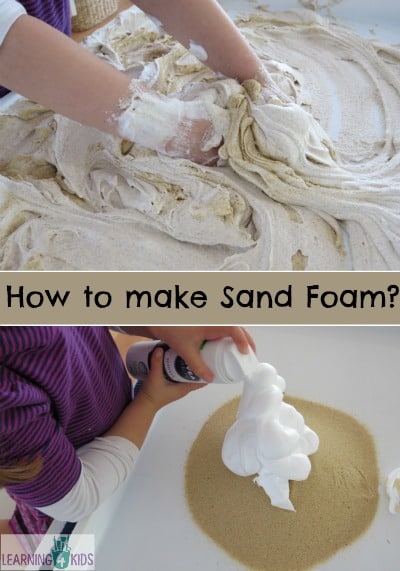
HOW TO MAKE SAND FOAM?

How to make sand foam for sensory play by learning 4 kids
How to make Sand Foam?
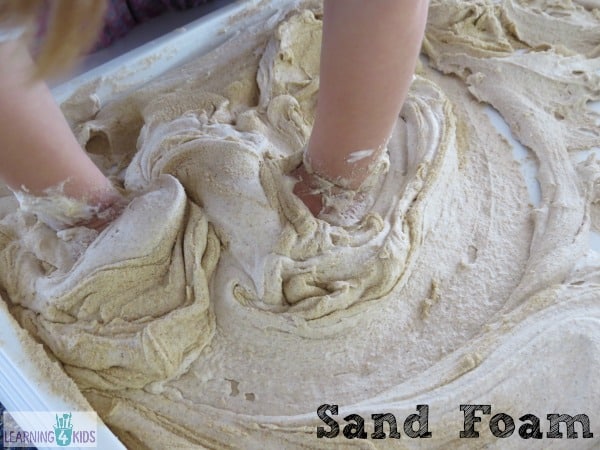
Sand Foam is perfect for sensory exploration. It is made up using only two ingredients, sand and shaving cream.
Kids will love running their hands and fingers through the fluffy, textured mixture.

WHAT WE WILL NEED?
You will need clean sand, shaving cream and a large tray or tub.
There is no real defined amounts for the ingredients, the sand and shaving cream amounts can be adjusted until you are happy with the consistency. We started off with 3 cups of sand and 200ml of shaving cream, however, we added another 3 cups of sand to our mixture to explore what would happen.

INSTRUCTIONS:

  1. Add 3 cups of sand to the tray.
  2. Gradually add the shaving cream and combine using hands. Add more shaving cream until desired consistency is made.

LET'S PLAY
sand foam for sensory play experiences


LET'S LEARN
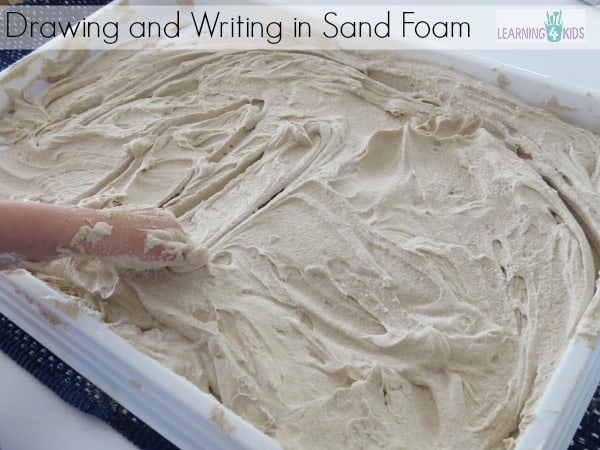
drawing and writing in sand foam by learning 4 kids


  • Creativity
  • Fine Motor Development – Pre-writing skills
  • Hand-Eye Coordination
  • Sensory- Development of the sense of touch. Feeling and manipulating objects.
  • Oral language development- using descriptive language.

We plan to repeat this activity but next time using coloured sand and maybe a touch of glitter too!

RICE AND ICE SENSORY ACTIVITY

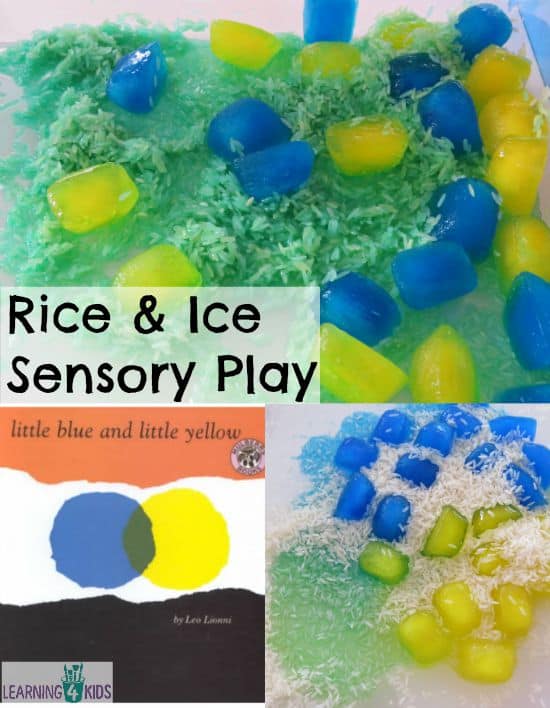
Rice and Ice Sensory Play -learn about rhyming words, absorption and colour mixing.

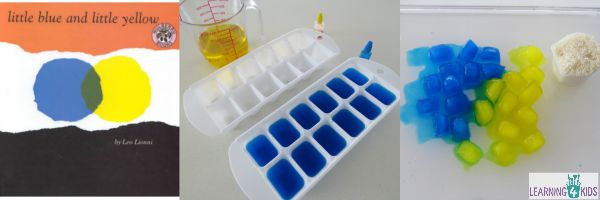
Rice and Ice Sensory Activity is a fun activity that provides an opportunity to play with rhyming words, explore scientific concepts and learn about primary colour mixing with all the benefits of sensory play.

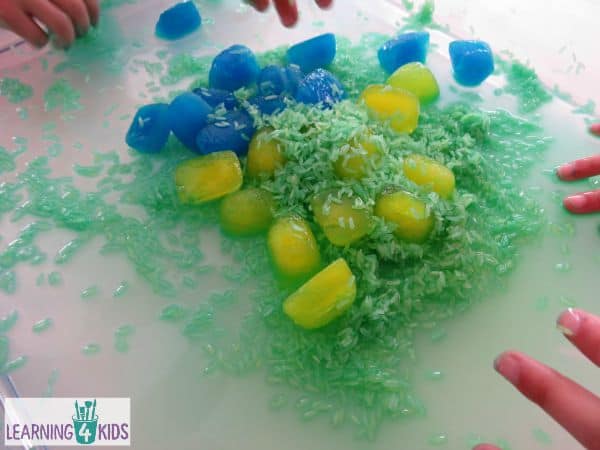
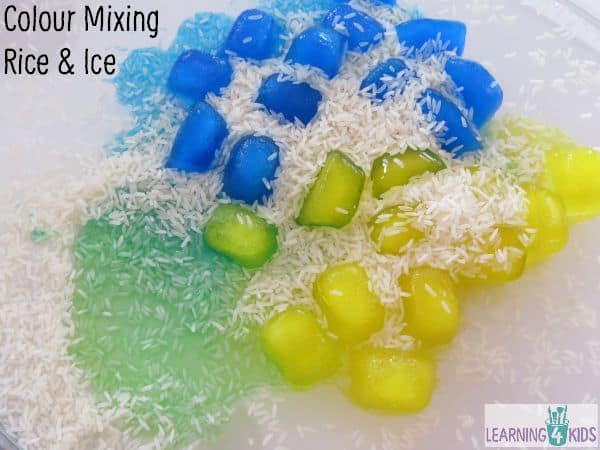
To begin this activity we read the story Little Blue and Little Yellow by Leo Lionni which is a perfect fit for mixing primary colours. We have been learning about mixing primary colours and this Rice and Ice Sensory activity is a great way to continue the learning in a multi-sensory way. Children are able to watch the colour of the rice change as the blue and yellow ice begin to melt and combine to create a secondary colour, green.

WHAT we WILL NEED?

Little Blue and Little Yellow Primary Colours Activity with rice and ice sensory tub
You will need the story Little Blue and Little Yellow by Leo Lionni, two ice cube tray, yellow and blue food colouring, water, large tub and 1 cup of dry uncooked rice.


LET'S PLAY

rice and ice sensory fun - an activity inspired by the book Little Blue and Little Yellow by Leo Lionni
  • Talk about the rhyming words rice and ice: can you think of another word that rhymes with rice and ice? Words such as mice, twice, vice, nice and so on. You may like to try and write these words in the wet rice on the tray.
  • Talk about the two different coloured ice blocks and make predictions about what will happen. Make connections with what is happening in the sensory tub and the story Little Blue and Little Yellow.
  • Sort the coloured ice into groups according to colour.
  • Line all the ice blocks up around the outside of the tray. Try to build and stack with the ice blocks.

LET'S LEARN

Colour Mixing with Rice and Ice - great activity to demonstrate mixing primary colours

  • Language development: Using descriptive words to express ideas and opinions.
  • Phonological awareness: rhyming words
  • Make connections with real life experiences.
  • Promote scientific thinking: predictions, observations, comparison, reasoning, data gathering, experimentation and evaluation.
  • Scientific concepts: absorption, solids and liquids
  • Hand-Eye Coordination and Control
  • Cause and Effect
  • Concentration
  • Colour recognition – name and recognise colours