lunes, 28 de mayo de 2018

SCHOOL PARTY

Summer is arriving, and some of our students are going to go on holidays. To say good bye to them, we have decided to do a school party.

We have prepare a lot of funny activities and a delicious lunch; we made ice creams, we painted on the playground, we did races, we sang summer songs, etc. In de lunch we ate a lot of tasty food.
It was fantastic!!!

 Resultado de imagen de niños de 2 años corriendo


Resultado de imagen de niños cantando


TACONERA EXCURSION

Last friday, we went to La Taconera. We went walking because our infant school is near this place. At 9:00 pm we left the school and around  9:45 we were at there.
We saw the animals such as the peacock, the hens, the swans, the deers etc. Also, we saw the nature of La taconera that is very beautiful and has a lot of grass, flowers...
Children learn a lot about the animals and the nature and they also had a new experience in their lifes. 
This excursion was so enriching for them.


martes, 22 de mayo de 2018

ARTICLE

Let's Play! My Little Thumbkin & Sticky Situation

Fingers are fascinating to your baby because he's discovering how much they can do. In the classic children's singing game "Where Is Thumbkin?" the individual digits of each hand really come to life.

Appropriate for: 9 months to 2 years
Skills developed: Fine motor, auditory
What you'll need: A nonpermanent pen

Use a pen to draw a small face on the pad of each of your fingers and both thumbs. Start by making fists and holding them both out in front of your baby, clenched tight so no fingers show. To the tune of "Frère Jacques," sing:

"Where is Thumbkin, where is Thumbkin?"
"Here I am, here I am" (bring out one thumb, then the other),
"How are you today, sir?" (make one thumb bow),
"Very well, I thank you" (the other thumb returns the bow),
"Run away, run away" (put one hand, then the other, behind your back).

The song repeats with each finger called by name: Pointer, Tallman, Ringman, and Pinky. Then, for the grand finale, sing, "Where's the whole family?" waving all five fingers together on "Here we are." If you've given each finger-face a slightly different expression, this last verse is a hilarious hands-down winner.


Sticky Situation

When your baby has mastered the knack of picking up and manipulating toys, she's ready for the surprise silliness of this captivating challenge.
Appropriate for: 9 to 18 months
Skills developed: Fine motor, hand-eye coordination
What you'll need: A piece of contact paper, tape, and a few small toys

Take a piece of sticky contact paper, the kind you use for lining drawers and shelves, and place it, sticky side up, on your kitchen floor. Then tape it down securely along all four edges. (You can put some wrapping paper down first for extra floor protection.)

Gather an assortment of small toys and arrange them on the paper, pushing down on them to make sure they're firmly adhering. Then show your baby the toys and encourage her to pick them up – or try to. You'll both get a good laugh as your baby figures out how to get them unstuck.

Once all the toys are rescued, help her press her hands onto the contact paper. She's likely to be fascinated with the sensation of the sticky surface pulling at her palms as you help her lift each finger and put it down again. (Be sure to wash your baby's hands after since she's also likely to put them in her mouth.)
Remember: Each baby develops at a different pace, so if yours isn't quite ready for this week's activities, don't worry — just try them again in a few weeks.


PAGE OF THE ARTICLE  https://www.babycenter.com/0_lets-play-my-little-thumbkin-sticky-situation_1498504.bc


viernes, 18 de mayo de 2018

SOME FAVORITE WATER ACTIVITIES FOR PRESCHOOLERS

Preschoolers love water.
Give them a tub of water and a cup and they will fill and pour water over and over again.
So why not add on to this with some fun hands-on learning? I’ve put together a variety of ways to use water. Activities that allow them to:
  • Feel
  • Squeeze
  • Pour
  • Poke
  • Explore
PLAY WITH WATER!

These activities can be done year round, in the classroom or at home. With one child or many children. 

 Preschoolers love water activities all year around. Thank goodness there are so many different ways of playing with it. We've collected 15 favorites that encourage hands-on learning!

CUENTOS INFANTILES. NEW.

Los cuentos infantiles que hemos leído en nuestra infancia han influido en el camino que hemos tomado para ser quienes somos.

Todos los cuentos infantiles que a lo largo de nuestra infancia nos han leído nuestros padres han influido, sin ninguna duda, en el camino que hemos tomado para ser quienes ahora somos. Los cuentos infantiles nos han enseñado mucho por sus moralejas, y nosotros esto se lo debemos a nuestros padres que nos los leyeron una y otra vez con todo el cariño del mundo.

Moralejas de cuentos infantiles

  • El patito feo. La auténtica belleza está en la personalidad de cada uno, y no hay que dejarse nunca hundir por los demás.¿Cuántas veces discutimos en el patio de nuestro colegio? ¿Cuántas veces la envidia llevó a nuestros enemigos a una crítica destructiva? La moraleja de este cuento infantil nos ayudó a conocer nuestro valor, y a saber que esos insultos banales no tienen ningún poder sobre nosotros.
  • El traje nuevo del emperador. La moraleja de este clásico es hacer saber a los niños que lo correcto es guiarse por el criterio propio, y no por lo que digan los demás. Quizá alguna vez desobedecimos a nuestros padres y no hicimos lo que ellos querían. Pero eso resultó ser bueno, ya que a través de nuestras decisiones conseguimos ser felices. Por muy tópico que suene, debemos llevar la vida que deseamos, pero no la que otros quieren que vivamos.
  • La liebre y la tortuga. Es uno de los cuentos infantiles con más significado, ya que enseña a los niños el valor de la humildad, el esfuerzo y la perseverancia. Dicen que es la clave del éxito, y es que la humildad y el esfuerzo nos llevan a donde queremos llegar. No sólo en una carrera como el cuento explica, sino en todo lo que nos propongamos. Durante los años de universidad, por ejemplo, muchos queríamos tirar la toalla, pero sin darnos cuenta del cuento infantil de “La liebre y la tortuga”, aquel que nos hizo perseverar, y gracias a ello conseguimos el trabajo que nos apasiona. Y si aún no lo hemos encontrado, sólo hay que seguir actuando como esa tortuga que con esfuerzo terminó la carrera proclamándose ganadora.
  • La mata de habas. Nos ayudó a comprender que la bondad suele tener su recompensa. ¿Por qué no decirlo? Alguna vez este cuento infantil nos ha hecho tener altas expectativas y no fue del todo así. Es cierto que existen personas malas a las que les suceden cosas buenas, pero no es lo habitual. La vida nos suele devolver lo que hemos hecho, y es cierto que cuanto mejores seamos con el entorno que nos rodea, mejos nos tratará dicho entorno.
  • El sastrecillo valiente. Es otro de esos cuentos infantiles que ayudan a la confianza en uno mismo y, además promueve el espíritu emprendedor que todos deberíamos tener. Todos tenemos un don diferente que, si queremos llegar al éxito, debemos desarrollar. Siempre se dice que es importante potenciar virtudes y corregir defectos. Debemos luchar, creer en nosotros y hacer lo que nos gusta de la mejor manera. Esto es porque siempre podemos mejorar, y hacer una nueva versión de nuestra persona.
moraleja-cuentos-infantiles1

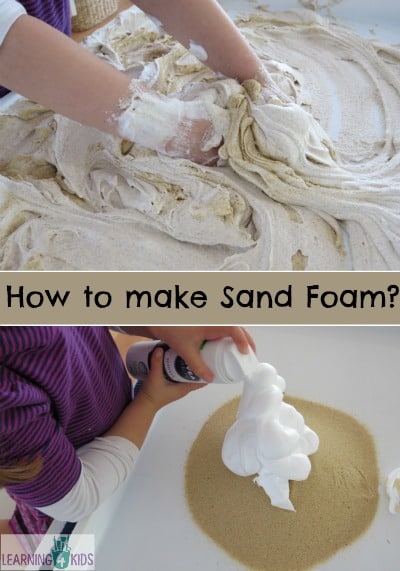
HOW TO MAKE SAND FOAM?

How to make sand foam for sensory play by learning 4 kids
How to make Sand Foam?
Sand Foam is perfect for sensory exploration. It is made up using only two ingredients, sand and shaving cream.
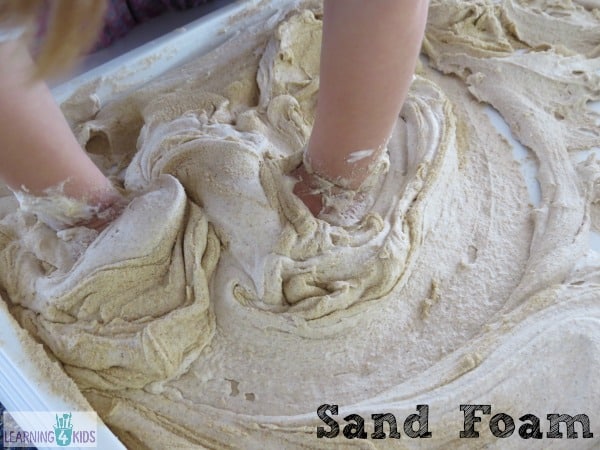
Kids will love running their hands and fingers through the fluffy, textured mixture.

WHAT WE WILL NEED?
You will need clean sand, shaving cream and a large tray or tub.
There is no real defined amounts for the ingredients, the sand and shaving cream amounts can be adjusted until you are happy with the consistency. We started off with 3 cups of sand and 200ml of shaving cream, however, we added another 3 cups of sand to our mixture to explore what would happen.

INSTRUCTIONS:

  1. Add 3 cups of sand to the tray.
  2. Gradually add the shaving cream and combine using hands. Add more shaving cream until desired consistency is made.

LET'S PLAY
sand foam for sensory play experiences


LET'S LEARN
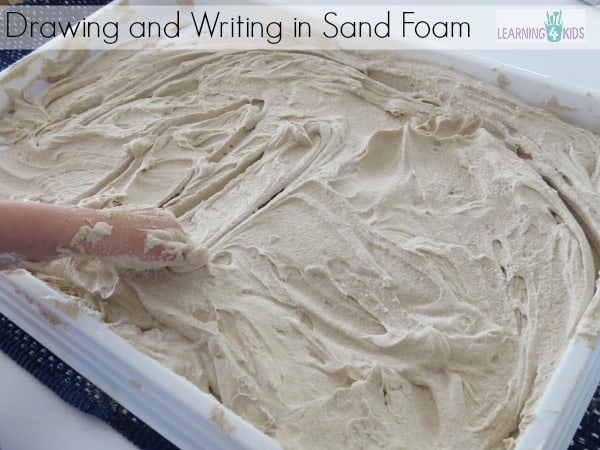
drawing and writing in sand foam by learning 4 kids


  • Creativity
  • Fine Motor Development – Pre-writing skills
  • Hand-Eye Coordination
  • Sensory- Development of the sense of touch. Feeling and manipulating objects.
  • Oral language development- using descriptive language.

We plan to repeat this activity but next time using coloured sand and maybe a touch of glitter too!

RICE AND ICE SENSORY ACTIVITY

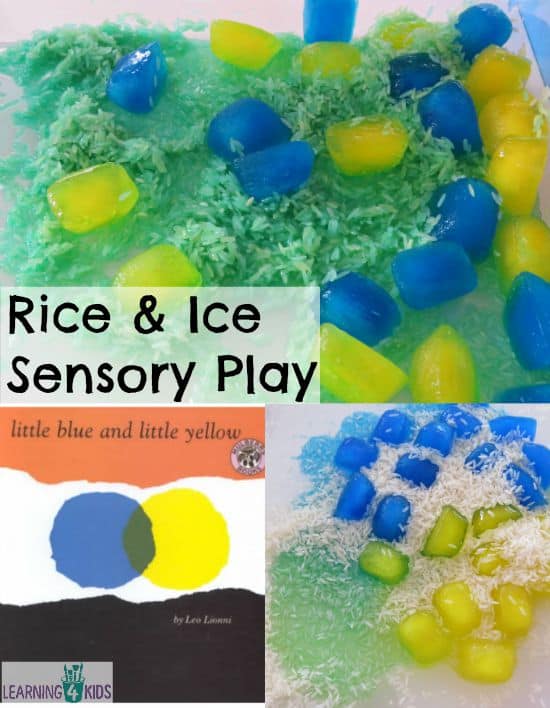
Rice and Ice Sensory Play -learn about rhyming words, absorption and colour mixing.

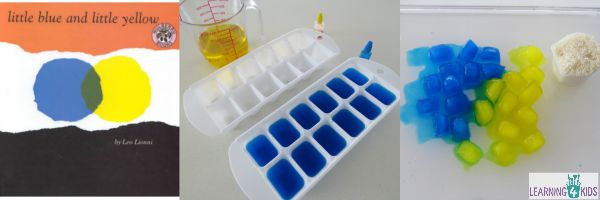
Rice and Ice Sensory Activity is a fun activity that provides an opportunity to play with rhyming words, explore scientific concepts and learn about primary colour mixing with all the benefits of sensory play.

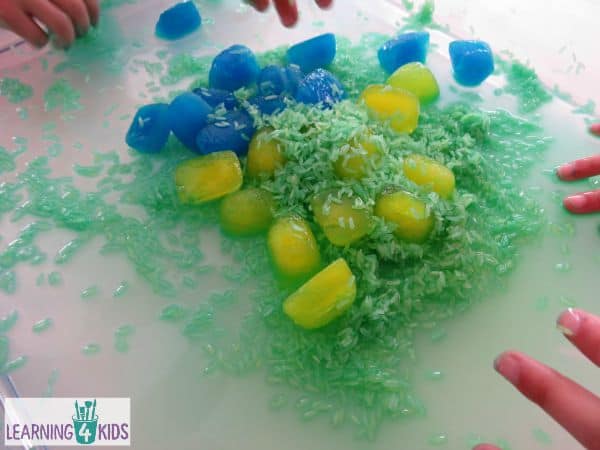
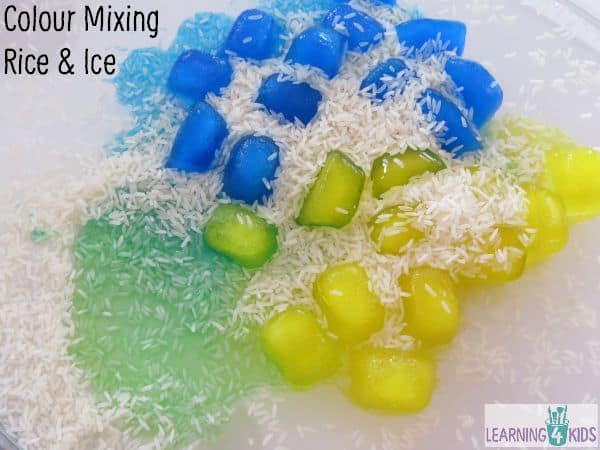
To begin this activity we read the story Little Blue and Little Yellow by Leo Lionni which is a perfect fit for mixing primary colours. We have been learning about mixing primary colours and this Rice and Ice Sensory activity is a great way to continue the learning in a multi-sensory way. Children are able to watch the colour of the rice change as the blue and yellow ice begin to melt and combine to create a secondary colour, green.

WHAT we WILL NEED?

Little Blue and Little Yellow Primary Colours Activity with rice and ice sensory tub
You will need the story Little Blue and Little Yellow by Leo Lionni, two ice cube tray, yellow and blue food colouring, water, large tub and 1 cup of dry uncooked rice.


LET'S PLAY

rice and ice sensory fun - an activity inspired by the book Little Blue and Little Yellow by Leo Lionni
  • Talk about the rhyming words rice and ice: can you think of another word that rhymes with rice and ice? Words such as mice, twice, vice, nice and so on. You may like to try and write these words in the wet rice on the tray.
  • Talk about the two different coloured ice blocks and make predictions about what will happen. Make connections with what is happening in the sensory tub and the story Little Blue and Little Yellow.
  • Sort the coloured ice into groups according to colour.
  • Line all the ice blocks up around the outside of the tray. Try to build and stack with the ice blocks.

LET'S LEARN

Colour Mixing with Rice and Ice - great activity to demonstrate mixing primary colours

  • Language development: Using descriptive words to express ideas and opinions.
  • Phonological awareness: rhyming words
  • Make connections with real life experiences.
  • Promote scientific thinking: predictions, observations, comparison, reasoning, data gathering, experimentation and evaluation.
  • Scientific concepts: absorption, solids and liquids
  • Hand-Eye Coordination and Control
  • Cause and Effect
  • Concentration
  • Colour recognition – name and recognise colours

TOP 7 THEETHING SINGS

7 THEETHING SINGS


VIDEO. WHAT ARE THE LONG TERM BENEFITS OF PRESCHOOL?

BAB'S FIRST YEAR

By Day, Hendricks, Palmer 

Baby's First Year
In this special section you’ll find information on Developmental Milestones, Bonding and Attachment, and Infant Safety.
To gaze upon any number of babies is to be in observance of little pioneers forging their own individual frontiers. As a caregiver, you provide the space and the stimulation, but the babies follow a set of step-by-step instructions. They will all get where they are going, but each baby at a different pace from the next.
How can a caregiver be assured, amidst such differences, that her little charges are on track? Just as a daily schedule helps babies feel safe and secure by providing a predictable routine, caregivers can feel more confident in their jobs by knowing what to expect of infant development. So assuming your environment is conducive to movement and learning, your interaction with babies is lively, the meals are balanced, and the manipulatives enriching, you will see exciting changes during baby’s first year.*

Bonding and Attachment
By Clare Adrian Day
Infant caregivers are in the profession because they love babies, but this is only half of the equation for high-quality infant care. The other half is the invisible bond that forms during feeding, playing, comforting, and reacting to baby’s signals with timed and thoughtful responses. At the end of the hour, day, or week, however long it takes for each unique child, the caregiver who responds to babies with the steadiness of a heartbeat can be assured that her relationship with baby is second only to the bond she shares with her parents. 

Understanding Baby’s Needs
Although there has been much debate about whether to respond to baby’s every cry, many psychologists agree that responding with immediacy to a crying baby fosters early independence. When an adult reacts quickly, baby learns that her needs will be met and that she has a safety net when exploring new things. As caregivers begin to bond with the infants in their care, they will soon learn the various types of baby’s cues and how to respond. Not every cry means, “I’m hungry.” There’s a difference between a cry signaling a change of diaper and a cry that says, “I’m bored. I need more stimulation,” or “Come closer, I’d like to be held.”

Meeting Baby’s Needs
Not only do different cries have different meanings, but each baby is an individual who responds to your signals of care differently. What works for one baby, may not work for another of a different temperament. The creative caregiver has a variety of methods to calm a baby, which may include holding baby close, cradling baby in your arms, swaddling her in a blanket, holding her face-to-face, talking in low quiet tones, or singing a lullaby. Baby will let you know which one of these methods works best, and soon you’ll know exactly how to soothe him.

Making the Transition
As parents leave you with their treasured baby, they may need your support and encouragement to ease themselves and baby into the transition from home to child care. Here are a few suggestions for making the transition as smooth as possible.
·         Encourage parents to bring baby to your program for short periods of time a few days before full-time care begins. 
·         Ask parents to bring a blanket, toy, photograph, or some other familiar item from home for baby.           
·         Hold, cuddle, and let baby know you’re nearby. As your face becomes familiar to baby,so does your smell and the sound of your voice.
·         Build a language rapport with baby by making a sound and waiting for baby to make a sound, then make another sound and wait and on and on until one of you tires, preferably baby.
·         Sing a song or tell a story while diapering, eating, or transitioning baby from one activity to another.

The Miracle of Touch
One doesn’t have to be a certified therapist to know that loving, kind, caring, soft touch feels good. Through your touch, baby will receive the message that there is nothing to fear. Here are some games and activities you can try. 
·         Stroke baby with soft objects such as a furry teddy bear, a feather, or a soft piece of cloth.
·         Play rhyming games such as, “To Market, To Market” or “This Little Piggy” on baby’s toes.
·         Rock baby to sleep and hold him during feedings. 
·         Play a game of peek-a-boo to remind baby that even though you go away, you always come right back.
·         Give baby lots of kisses and tickle him until he squeals with glee.

Clare Adrian Day is a freelance writer and former early childhood parent educator.

Developmental Milestones: 1-3 Months*
  • Swats moving and/or hanging objects with hands
  • Kicks legs when placed on back or tummy
  • Opens and closes hands
  • Tracks objects with eyes
  • Lifts chest and head when placed on stomach
  • Starts smiling at familiar faces
  • Begins to coo and babble
  • Recognizes familiar sounds and turns head toward sound
  • Attracted to pictures and photographs with striking colors and contrasts

Infant Safety
By Charlotte Hendricks
The first year of life is exciting for both baby and his parents. Mom and Dad are thrilled by each and every new development in baby’s life – first tooth, first words, and first steps. During the first year, babies see faces, people, and objects, and then they begin to reach for them. Next thing you know, babies are mobile and exploring the wonders of their environment! There are two key concepts in this statement – mobile and explore. It’s amazing how quickly an infant can reach for an object, and put that object into his mouth. These characteristics make safety a never-ending challenge. In this article, we list the most common infant safety hazards and describe how you can keep baby safe in your program and at home.

Floors
A baby’s line of vision begins at floor level and ends at about two feet. To really see potential hazards, you should get down on all fours and look around. You can expect to find choking hazards, such as paper clips, coins, a peanut, or a vitamin under a chair, hiding underneath a countertop, or nudged into a corner. From this perspective, you’ll also see dirt and debris tracked in from your shoes, including chemicals from a treated lawn. To ensure an infant’s safety, do a daily “floor check” to remove all choking hazards from under and behind furniture. If your infant room is carpeted, be sure that it is properly swept and professionally cleaned on a regular basis. Linoleum floors should be sanitized daily with a bleach and water solution.

Electrical Outlets
Most electrical outlets are directly at a baby’s eye level. You can be sure an infant will not only find the outlet, but explore it with his little fingers. To prevent injury, be sure all outlets, even those out of baby’s reach, are securely covered. In addition, keep cords of all appliances short and away from baby. An infant pulling on a cord can easily cause heavy objects to crash to the floor or even worse on him.

Falls
One of baby’s first triumphs, at around the age of eight to 12 months, is the ability to climb up. Babies love to practice their new skills and will likely climb out of their cribs, up stairs, and onto chairs, which can then provide access to countertops and changing tables! While a fall from a chair or sofa is not likely to cause serious injury, a fall from a countertop can be deadly. Constant supervision is the key to preventing such falls. Also, try to avoid putting infants in walkers. Walkers give babies instant mobility, which can lead to a crash into a wall or a bumpy ride down a staircase.
To eliminate climbing hazards, place sturdy safety gates at both the top and bottom of staircases, as well as at doorways to other rooms. The bottom of the gate should be less than three inches from the floor to prevent the child from crawling under it and becoming trapped. Be sure the gates are secure and cannot be pushed or pulled down. Never use accordion style gates. A gate of this type can strangle a child. In addition, always keep one hand on baby at all times when diapering. An infant can fall from a changing table in the few seconds you turn your back. High chairs should have sturdy wide bases and include all safety straps, including the strap that goes between the child’s legs.

Suffocation and Strangulation
To make naptime as safe as possible, place infants in cribs that have firm, close-fitting mattresses and sheets that stay securely on the mattress. Dress infants in warm pajamas to eliminate the need for blankets and never place pillows or stuffed toys in the crib. In addition, always put baby on his back to sleep, not his stomach. To ensure crib safety, there should be no more than 2 3/8 inches between crib slats and corner posts should not protrude more than 1/16 inch above the end panels. Eliminate entrapment hazards by selecting cribs that do not have cutout or carved areas on the headboard or footboard.

Windows
Keep all window treatments and blind cords away from baby’s reach. In addition, be sure that all cribs and highchairs are kept a safe distance away from windows to prevent access. Because babies are “top heavy” they can easily topple out of windows. A screen alone will not prevent baby’s fall from a window.

Safety devices
Remember that no room or area is ever completely “child proof.” Although latches and locks can be installed on cabinets, toilets, and refrigerators, these devices will only help in slowing down a child’s access. You’ll find that many children will quickly learn how to open the latches and locks. The same is true of child-resistant caps on medication bottles. These can delay, but not always prevent access. Again, your constant supervision and daily removal of potential hazards are the keys to keeping baby safe and sound.


Developmental Milestones: 4-7 Months*
  • Begins using eyes and arms together to bat, reach, and grasp
  • Explores everything within reach
  • Passes objects from one hand to another
  • Rolls over
  • Sits with or without the support of hands
  • Returns smiles
  • Begins participating in social games and activities
  • Expresses interest in mirrored  images
  • Jabbers and begins to use single syllables
  • Explores to find hidden objects  

Food Safety
By Sharon Palmer
We’ve all seen the headlines: Four children fall prey to contaminated hamburger meat. Child dies after consuming peanut butter cookie. Five-month-old baby perishes, milk allergy is the suspect. Because infants have undeveloped immune systems and lower body weights, they are at greater risk for food borne illness. In addition, research indicates that eight percent of children may be affected by food allergies. Young children rely totally on their caregivers to manage their food intake and ensure that it is safe. A child’s first year is an exploration of sights, sounds, sensations and tastes. Providing a safe, nutritious journey into this world is one of our most important challenges.

Food Safety Is in the Bottle
A crystal clear baby bottle decorated with teddy bears may appear innocuous enough, but all manner of threats may be lurking in its sparkling depths. When handling children’s bottles, use the following safety tips.
  • Sanitize baby bottles and nipples, even bottles with disposable liners, by washing them in hot soapy water and rinsing them in clear hot water and a sanitizer rinse (11⁄2 tablespoon liquid chlorine bleach per one gallon water). Allow bottles to air dry. Placing bottles, nipples, and tops in the top shelf of a dishwasher is an appropriate method of disinfection, assuming that the dishwater  achieves a temperature of 160°F.
  • Label all filled baby bottles with the infant’s name and date to avoid confusion.
  • Refrigerate baby bottles below 40°F. If a bottle is left out for more than two hours, discard contents.
  • Use all prepared infant formula within 48 hours. After this, contents should be discarded.
  • Use expressed breast milk within three days, if stored in refrigerator. Frozen breast milk should be defrosted in the refrigerator and not left out on the counter at room temperature for defrosting.
  • Use caution when heating bottles in a microwave, as hot spots may occur. Avoid using a microwave to heat breast milk. Plastic bottle liners may explode in a microwave. A better method of heating bottles is a hot water bath or commercial bottle warmer. Test the temperature of the warmed bottle on the back of your hand to ensure that it is merely tepid.
  • Discard leftover contents of all bottles after feeding due to potential bacterial contamination.
  • Never give an infant another child’s bottle.
  • Maintain records of children’s nutritional intake, including formula type or breast milk, amounts, and frequency.
  • Never prop up a bottle during feeding, as choking may occur.
  • Avoid putting solids or cereal in a bottle, as this may also cause choking.

Sharon Palmer is a registered dietitian, mother of two, freelance writer, and instructor of children’s cooking classes in Southern California.

Developmental Milestones: 8-12 Months*
  • Understands and enjoys playing peek-a-boo
  • Pulls up to a standing position
  • Grasps a toy in each hand and bangs them together
  • Walks without assistance
  • Imitates actions and words
  • Begins using simple words such as mom, dad, and bye-bye
  • Picks up toys and lets go
  • Expresses separation anxiety when away from mom and dad
  • Plays games such as shoving a ball back and forth between self and caregiver and associating the  open-close hand movement with the sound of “bye-bye”

ARTICLE: TOYS THAT TEACH: MAKING AGE-APPROPIATE CHOISES

By Angie Dorrell, M.A.
Searching for toys and materials in the various early childhood supply catalogs, local toy stores, and specialty stores is both a fun and daunting task. Some toys and materials are a better choice for young children than others, and you can make appropriate choices by doing your homework. The best toys actively engage children in many areas of development and can be used in a variety of ways, depending on the child’s interests, ability, and imagination. 
Young children are naturally curious and providing them with high-quality (which may not mean expensive) materials is important to the learning process. Toys that encourage children’s imagination help them know that the world is a diverse and wonderful place. While children may clamber for the “toy of the moment,” don’t let the hype sway your decision. Jump ropes, jacks, and blocks continue to be favorites of children everywhere.
 Learning Across the Curriculum
Through play experiences, children learn about themselves, their environment, and the people in their lives; experiment with different ways to solve problems; develop body control; practice social skills; and express their creativity. Children gain confidence as they choose toys and materials that are of particular interest to them. An environment that encourages children to make their own choices helps them feel safe, valued, adventurous, competent, and confident to take the initiative. Observe children at play over a period of time, and you’ll see higher levels of thought form in all areas of development – physical, language, social-emotional, and cognitive.  
Physical Development
Appropriate toys and materials encourage children to build muscle control, strength, body awareness, balance, and dexterity. Children preschoolers to use their creativity and and develop his fine motor skills.
Language Development
Beginning with cooing games and evolving to sophisticated language levels, such as telling stories and jokes, children develop their language skills. Providing children with age-appropriate toys gives them unique and interesting topics to talk about. Books and recordings help children appreciate words, literature, and music, and pretend play objects encourage children to talk with each other.
Social-Emotional
Children learn to cooperate, negotiate, take turns, and obey rules through play. Creative art, movement, and drama materials foster creativity, are an appropriate emotional outlet, and provide another view of life. When children put on dress-up clothes, they learn to express themselves and to be comfortable in different roles, which in turn leads to self-expression and socialization opportunities. 
Cognitive
Toys and materials that promote active learning motivate children to pursue their own ideas and interests enthusiastically. Many toys, for example, encourage children’s interest in concepts like same/different, patterned/planned, classifying, and sorting. Construction items help children learn about science and number concepts, and hardwood unit blocks help children learn about geometry, gravity, shapes, and balance. Children practice problem solving as they figure out how things work, and when children create with paint, they learn to mix colors and to use their own unique ideas, which helps them in exploring and discovering consequences.
Age-by-Age: Selecting Appropriate Toys
Children are amazingly resourceful and creative. They will transform cardboard boxes into space ships, stones into animals, and cardboard tubes into telephones. Children don’t need the most expensive toys and equipment for optimal learning, but there are guiding principles and helpful processes to use in evaluating and selecting the most appropriate toys and materials for young children. The following suggestions will guide teachers and parents in making appropriate toy choices. 
Infants (Birth – 18 months)
Properly selected toys provide baby with opportunities to learn about size, shape, sound, texture, cause and effect, and repetition. Here are some other infant toy selections and guidelines. 
·         Brightly colored, lightweight toys with texture encourage baby to touch and explore. 
·         Mobiles, safety mirrors, musical and chime toys, crib gyms, busy boxes, nesting and stacking toys, simple pop-up toys, bathtub toys, simple rattles, and teethers all promote baby’s learning and development. 
·         Soft, squeezable toys help baby practice grasping and reaching.
·         Push-pull toys strengthen muscles.
·         Dolls encourage baby to imitate what he sees adults doing and to make sense of his world.
·         Simple press-together bricks, blocks, or pop beads develop eye-hand coordination.
·         Children’s books – cloth, vinyl, and cardboard – enhance language development.
·         Different types of music invite baby to experience different rhythms and sounds.
Toddlers (18 months – 35 months)
Toddlers are very active and physical. They enjoy playing make-believe and imitating the adult world they see. They are not yet ready to actively play with each other, but they may choose to play beside each other. The following selections promote these skills and more.
·          Pegboards with large pegs encourage the development of gross motor skills and strengthen the pincer grasp.
·         Stable ride-on materials powered by the child increase balance.
·         Play sets with people, animals, and cars expand language skills.
·         Objects that pop up with dials, switches, and knobs teach cause and effect.
·         Simple puzzles with knobs and chunky pieces develop eye-hand coordination and help toddlers understand how things fit together.
·         Push-pull items, such as shopping carts and doll buggies, encourage walking while giving children the opportunity to imitate adults.
·         Children’s music allows toddlers to experiment with different sounds, rhythms, and patterns and increase their body awareness.
·         Dolls help toddlers make sense of their world and imitate adult behavior.
·         Large items for stringing and lacing develop eye-hand coordination and fine motor skills such as grasping.
·         Children’s books with simple, colorful plots and pictures expose toddlers to different speech patterns and new vocabulary. 
Preschoolers (3 – 5 years old)
Preschoolers are masters of make believe. They are interested in each other and the world around them, and they enjoy showing off their new number and alphabet skills. Below are suggested products for supporting and encouraging a preschooler’s developing skills.
·         Dramatic play items such as dress-up clothes, pretend food and dishes, and dolls help children learn to cooperate and share with others.
·         Puppets encourage preschoolers to explore the difference between fantasy and real-life and expand language skills through storytelling.
·         Sand and water toys, such as boats, funnels, pails, and scoops allow children to explore size, weight, measurement, and other science and math concepts.
·         Complex construction materials that interlock in various ways encourage preschoolers to use their creativity andmath skills such as patterning, classifying, and sorting.
·         Simple unit blocks and accessories such as animals, vehicles, and furniture provide opportunities for preschoolers to balance, understand size and weight relations, solve problems, and share materials.
·         Children’s music increases preschoolers’ self-confidence and body awareness and teaches them different rhythm patterns and appropriate ways to express themselves.
·         Simple games help preschoolers understand and follow rules and learn to cooperate with other children.
·         Active equipment such as jump ropes, balls, hula-hoops, and riding vehicles lead to increased body awareness, and the development of fine and gross motor skills, balance, and self-esteem.
School Age (6-12 years old)
School-agers are influenced by peers and have a strong gender identity. Older school-age children know how to cooperate and negotiate using advanced social skills. Mastery of academic skills enables them to pursue intellectual and creative experiences. 
·         Board games teach children to follow simple rules and enhance concepts such as math and reading in a fun way.
·         Complex puzzles encourage experimentation with cause and effect, strategic thinking, and problem solving.
·         Craft materials such as clay, beads, collage materials, paint, washable inkpads and stamps, washable markers, and scissors support creative expression and aesthetic awareness.
·         Complex construction sets and accessories allow school-agers to experiment with how things fit and work together, increase their fine motor skills, and express their creativity.
·         Fitness and fun materials such as balls, beanbags, and jump ropes help children gain self-confidence, exercise, release tension, have fun with others, and develop fine and gross motor skills.
·         Nonfiction and fiction books at different reading levels reinforce reading skills and provide information about other people and cultures.  

jueves, 17 de mayo de 2018

MUSIC CLASS

Last monday, we did a music class. The objective of this class was:
-To stilmulate the senses of the children
-To have fun.
-Develop their fine motor skills playing instruments.
-Change the activities that we do normaly.
-Know the sounds of different instruments.

Resultado de imagen de niños pequeños tocando instrumentos

FESTIVAL OF CULTURE WEEK


During our Festival of Culture week, our class learnt about Africa
We flew in our planes to Africa because it is very far away! We tasted the fruits from Handa's Surprise and played with African animals.  We even had a go at painting our own Tinga Art and made our own tribal necklaces.

RABBITS CLASS MEET RABBITS!!

Rabbits class enjoyed a visit from Pets at Home last week as part our our topic 'Caring for our World'.

We have been learning about how to care for the school guinea pigs and we have now also learned how to care for other pets. We met Biscuit the hampster, Midnight the guinea pig and our favourite was, of course, the rabbit!


DUG DAY

The class of olders had a wonderful afternoon sharing our learning with our Dads, Uncles and Grandads. Thank you to all who made the effort to join us - we hope you had fun!

viernes, 27 de abril de 2018

THE ADAPTATION TO THE CHILD TO THE SCHOOL

The school, at the beginning of the school term, is unknown for the child.

His fear is unfounded, since the incorporation of the child at the Centre is not a  separation  for children. Parents should keep in mind at all times that the educator is responsible for their  child. Personal stability allows you to contact with the child, and to have an emotional relationship with him that enrich you and provide you with the security you need.

We should take into acount that the child does not disting into  temporal abandonment and difinitive abandonment so he is going to cry, he is not going to eat or sleep etc. 

The child feels that he has lost his family but also feels that he wins a lot of friends, toys, games, with a educator that tells them storys etc and at this moment he is going to asimilate that he is going to have a good time in the school. He starts the socialization process.

In conclusion, the adaptation to the child to the school is difficult but we have to have patiente and give him a lot of affection.
Resultado de imagen de adaptacion del niño a la escuela

HOW WE CAN HANDLE THE TRANSTUMS?

The tantrums of the child always have some reason. Perhaps  he or se noticed by chance that their behavior gave results, but we should learn is that you it's improper conduct, that does not lead to anything and that does not help him in his frustration or rid you of an obligation or changed our way of thinking c on about something.

The main objective of the tantrums is to make a scene, not only when we give them what they seek, but also when we chastise him, we look to you, we are talking about trying to reason with them, etc. The fastest way to get rid of this behavior is therefore ignore the boy or girl, since there is no way of reasoning in the midst of an emotional start. If ignored you while you are in a safe place, it will teach you that tantrums are not effective and will learn to use them less frequently.

You can wait a few minutes to decrease their crying and tell him: 
"When you're done crying, returns and we go to play".
When the child finishes the tantrum should receive it as if it had nothing happened, giving you a chance to ingratiate himself with others, not to mention the incident.

Resultado de imagen de niño teniendo rabietas